

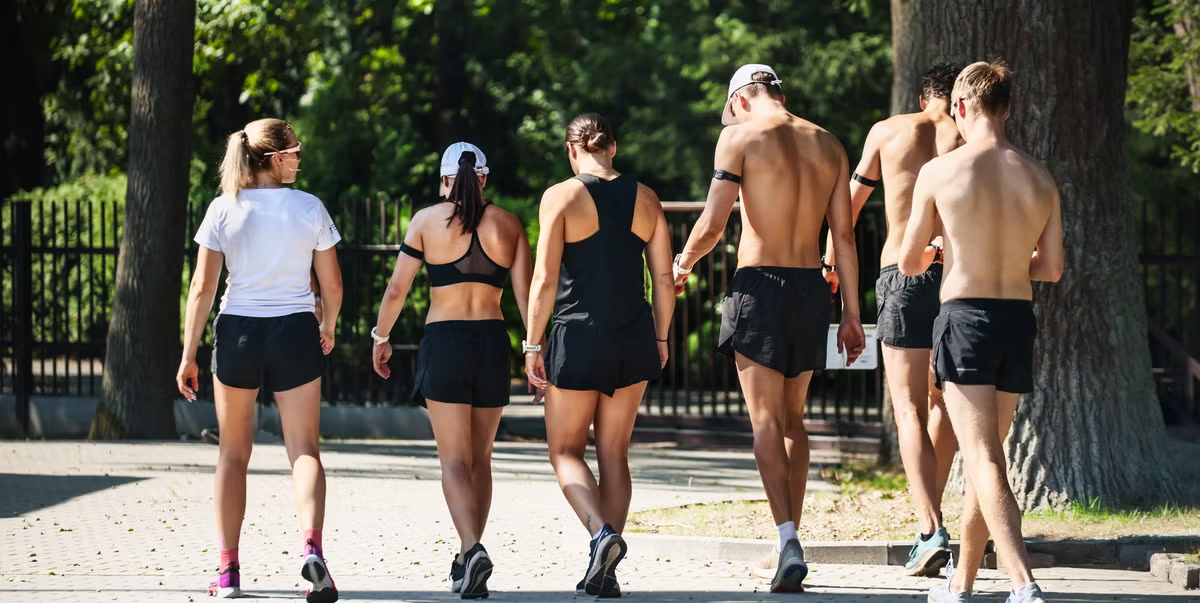
The run/walk method has been around since the 1970s and surged in popularity as more athletes have learnt that regular walk intervals may help you to run farther – and faster.
Olympic marathoner and running coach Jeff Galloway developed the run/walk method – or the ‘Galloway Method’ – for all types of athletes, from those who run sub-3-hour marathons to runners who are just getting into the sport. But there’s one rule that applies to all: in almost every case, the walk interval lasts for 30 seconds. This holds true whether the run intervals are four minutes or 10 seconds long.
Chris Twiggs, chief training officer of the Galloway Training Programs, currently coaches between 220 to 250 athletes through the Galloway Method, including ultrarunners, people training for their first 5Ks, those who hope to qualify for the Boston Marathon and those aiming to finish a marathon in under seven hours. “Every single one of them,” he says, trains with 30-second walk breaks. “It’s just a question of how much running do we throw in.”
Noticing this common thread made us curious. What is it about that 30-second break that makes it appropriate for all types of runners? We asked Twiggs to explain the details to Runner’s World.
Why you need a 30-second walk interval
When Galloway started recommending the run/walk method back in the 1970s, he started with ‘run a mile, walk a minute’ – regardless of pace. Over time, though, as he and his team of coaches collected more data on how runners performed with the method, they started tweaking the recommendation, personalising the run ratios based on pace while still suggesting the one-minute walk.
They found that when training for longer distances, such as half marathons and marathons, runners started slowing during their later walk breaks, which dragged down their overall pace. For example, a runner might start out with a run/walk pace of 15:00 min/mile, but as the race wore on, they’d drop to a pace of 16:00 min/mile because of the slower pace during the walk breaks. To compensate for the slowdown, they’d push themselves to run faster during the run intervals, but that would backfire by making them more fatigued and cause them to walk even slower during subsequent breaks.
“By eight miles in a half marathon, or certainly by 20 miles in a marathon, I’m now walking significantly slower during my walk break than I was – and I’m having to run significantly faster than I was to make up for that,” explains Twiggs. “And it just becomes this downward spiral.”
That’s why, about a decade ago, the one-minute walk break morphed into 30 seconds, says Twiggs. “In 30 seconds, you’re getting the recovery benefits that you need from the walk, but you’re not slowing down [your overall pace] significantly.”
There is a catch, though – and, of course, as with any ‘rule’, there are some exceptions.
With the shortened walks, Galloway also shortened the suggested run intervals. For example, the early recommendation advised someone targeting a pace of 9:00 min/mile to run for four minutes and walk for one minute. Today, that pace suggestion is to run for two minutes and walk for 30 seconds. “This is the exact same amount of running and walking per mile,” explains Twiggs. “It’s just that by getting that break more frequently, we’re not slowing down as much during the walk if we’re able to consistently hold the pace that we want to hold, so we feel stronger throughout the run.”
Not every run/walker follows the 30-second walk rule. In fact, it can go towards both ends of the pace spectrum. One is people who primarily walk and incorporate small bursts of running to shake things up or to increase their average pace slightly, says Twiggs. These folks, for example, may walk for two minutes and run for 30 seconds, flipping the traditional run/walk to a walk/run. The Galloway Method recommends this sometimes for runners coming back from injury, as well people who want gentle cross-training as a break from their more intense run workouts, says Twiggs.
On the other side are very experienced runners gunning for super fast finish times – really, anyone wanting to sustain a pace of sub-7:00 min/mile, which equates to a sub-3 marathon finish time. In those cases, athletes will typically take a 20-second walk break, says Twiggs.
The benefits of 30-second intervals
There’s a notable perk to shorter running intervals. “It allows you to run at a more natural pace for you,” says Twiggs. As he explains, to complete a half marathon or full marathon, you have to run at an average pace that’s slower than what you’d run for a shorter run, such as a five-mile jaunt around your neighbourhood. However, there are only two ways to slow down your average pace. The first is to deliberately hold back while you run, which can compromise your biomechanics and cause more vertical oscillation up and down, says Twiggs. “Often, what we find is that when people are forcing themselves to run slower, they end up bouncing,” he says. This can cause more pounding on the joints, leading to an uncomfortable stride, he explains.
The other way to slow your pace is to inject regular walks into your runs. “Now, I can run the same pace for a half marathon that I’m comfortable running for five miles, but by putting in the walk breaks more frequently, it brings the average pace down to something that’s sustainable for the entire half marathon, or something that’s sustainable for the entire marathon,” says Twiggs.
Still, for the vast majority of athletes, those 30-second breaks are where it’s at.
Sometimes – but rarely – you need to walk for longer
There are a few instances in which Twiggs recommends taking more than a 30-second walk. One is if you start a workout or race too fast without a proper warm up, which can jack up your heart rate and push you into the anaerobic zone. “You want to recover from that as soon as possible,” says Twiggs. To help lower your heart rate, you can either add in an extra walk or lengthen an existing walk. Once you get back into the aerobic zone, he suggests resuming the 30-second walks.
But what if you feel extra tired towards the end of the race? According to Twiggs, it’s better to take more frequent short walks than fewer long walks. That’s because once you start extending the walks to a minute or so, it can be challenging to start running again. If you feel like you need a longer walk, you likely just need to shorten your run segment, explains Twiggs. For example, instead of doing cycles of three-minute run/30-second walk, you could shift to 2:30-minute run/30-second walk.
Remember that the 30-second walks are for tempo and long runs only. When it comes to speedwork intervals, like quarter-mile, half-mile, or mile repeats, you’ll need longer walks after each repeat to give your body time to properly recover from the high-intensity efforts. “We may put as much as five minutes of walking in between those harder mile efforts,” says Twiggs.
Become a Runner’s World Club member from just £1 for three months. Choose a Gold, Silver or Bronze membership that’s right for your training, motivation and reading experience.